
Faith deconstruction can be a quiet unraveling where questions slip into your mind, uninvited. Maybe you were reading a passage you’ve read a hundred times before, and suddenly, it didn’t make sense. Maybe a podcast cracked open something you didn’t know was fragile. Or maybe it was grief, betrayal, or burnout that tipped everything sideways.
Whatever it was, you found yourself staring at the pieces of a belief system that once felt sacred and safe, wondering how something so trusted could now feel so empty. That’s what I mean when I say, “when faith goes to hell.” Not just that it’s falling apart, but that it’s become the well of uncertainty you were taught to fear.
You’re Not Broken, Even if Your Faith Is
This disorientation you’re feeling? It sucks, but a lot of things that suck turn out OK, even when they leave scars. Deconstructing your faith isn’t any diifferent than the other hard stuff you’ve done.
Most of us were taught that certainty equals faith, questions are slippery slopes, and doubt is dangerous. But the truth is, nearly every spiritual tradition includes wilderness seasons and sacred unknowing. Even the Bible is full of stories of people wrestling with God, questioning everything, and surviving the fallout.
If you’re feeling untethered when deconstructing your faith, it’s not because you’ve lost your way. You may finally be waking up to your own path.

Why It Feels Like Everything Is Collapsing
Faith is rarely built in a vacuum. It’s connected to family, identity, relationships, community, and often our entire worldview. When one belief starts to unravel—like the idea of hell, the authority of the church, or the role of women—it pulls on all the others. It feels like the floor is giving out.
This is why deconstruction feels so destabilizing. It’s not just an intellectual shift. It’s emotional. It’s spiritual. It’s deeply embodied.
And it can be terrifying, especially if the version of Christianity you were taught says questioning is rebellion and that stepping outside of certainty is a one-way ticket to hell.
Sacred Doesn’t Always Mean Safe
One of the hardest things about deconstructing your faith is admitting some of the things you were taught to revere are actively harming people.
We were told that obedience brings blessings, but we watched systems protect abusers. We were taught that women should submit, but that submission often meant silence, harm, or invisibility. We were taught that questioning doctrine was the same as questioning God.
Some of those ideas were labeled “holy” because they served those in power to keep them unquestioned. It’s hard to let go of what you once called sacred, even when it causes you and others so much pain. But the truth is, you can grieve what you once thought was good, and still walk away from it.
You can grieve the God you were taught to love, the church that raised you, and the community you once trusted with everything.
There can be an overwhelming amount of grief when you lose a version of yourself who believed those things with your whole heart.

Letting Go Without Letting Go of Yourself
As you start to let go of the old, it can be easy to lose sight of who you are. You may wonder what’s left if you’re not the “good Christian girl” anymore. You may fear that your spirituality will disappear without the structure you once relied on. Who knows, maybe it will…
But here’s the things you need to remember while deconstructing your faith:
- You are more than your old beliefs.
- You are not owned by your past theology.
- You are still good, still whole, still worthy.
- You can connect with yourself in deeper ways.
- You don’t have to have all the answers.
- You can ground yourself in what is true for you right now.
What You Keep Is Yours to Choose
Contrary to what some may tell you, you don’t have to throw everything away. You’re allowed to keep the parts of your spirituality that still feel nourishing. Prayer. Breath. Beauty. Sabbath. Silence. Justice. Even Jesus.
You may find meaning in contemplative practices, ancient liturgies, poetry, or walks in the woods. You may find it in liberation theology, mysticism, or ancestral traditions. You are allowed to weave something new from the threads that still feel sacred to you.
The bottom line is that when deconstructing your faith, you get to choose what you pick up, what you leave, and what old structures you burn down.

Faith After the Flames
So what does faith look like after it’s been set on fire? Who knows? I sure as hell didn’t know what this season would look like until I got here, and I can confidently say that I’m not the only one.
So maybe the faith of your future is smaller and quieter. Perhaps it’s larger and louder. Maybe it no longer fits neatly into a doctrine or denomination. Maybe it’s something you feel in your body more than verses you recite.
This is a deep season of turning over the soil and digging up unhealthy roots that are choking out the good stuff that’s trying to grow. I hope you can find a tiny shred of hope that these things that feel like death are making way for new life.
The mucky, sometimes smelly soil you’re standing in?
It’s rich.
It’s messy.
It’s hard to move around in.
But it’s perfect for growing a spirituality that will nourish you for the rest of your life.
Please…Just…Keep…Going…
If you’re standing in the rubble of your old faith, wondering what comes next, keep reminding yourself that you’re in the middle of sacred work. Oh, and by the way…you are sacred and you are absolutely worth everything it’s taking to find your way through deconstructing your faith.
Here are a few places to invest your energy while you sort out what you believe:
- Let yourself rest more than you think you need to.
- Find a safe, nonjudgmental community, even if it’s not a faith community.
- Explore practices that connect you to your body and intuition.
- Be curious, not critical of what’s going on in your body.
- Let grief have its space, without shaming yourself for all this hurting you so deeply.
Just remember, there is deep, holy wisdom waiting for you beyond the edge of everything you were taught to believe.
Remember who you are, root deep in what is true, and listen to the whispers of your soul.

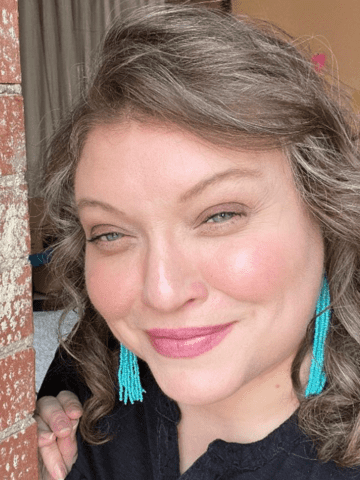
Angela Herrington is a spiritual coach and seminary-trained online pastor who has spent more than a decade helping people break free from toxic religious culture. She is the host of The Deconstructing Faith Summit, a Lark’s Song Certified Life Coach, a dynamic conference speaker, and the author of Deconstructing Your Faith without Losing Yourself. Her work has been featured in The New Republic, Religion News Service, Hope for Women magazine, and Authority Magazine.
She’s a firstborn, Enneagram 8, Gen Xer who loves to question everything. She holds a BA from Indiana Wesleyan and a Master in Leadership from Wesley Seminary. Her graduate research project focused on leadership development and opportunities for Gen X women in the US church.
Angela and her unique online ministry are featured in Lyz Lenz’s 2019 book God Land: Story of Faith, Loss, and Renewal in Middle America. She has published articles in Hope for Women and HOPE is Now magazines. She has been featured in The New Republic, Publisher’s Today, and Religion News Service.
Her first book, Deconstruct Your Faith Without Losing Yourself (Eerdmans February, 2024), shares her decade of experience as a coach in Christian spaces, personal stories, a hefty dose of compassion, and her trademark Gen X humor.
Her second book, Embracing the Old Witch in the Woods: Liberating Feminine Wisdom from Christian Patriarchy (Broadleaf, October 2025), is a road map for readers ready to challenge limiting beliefs, confront systemic injustices, and reclaim their inherent worth and wisdom. It helps readers reclaim feminine wisdom in order to liberate ourselves, our communities, and our souls, gaining strength and resilience through our connection to ourselves and to each other.
Angela is also a wife, a mom to 5, and a proud resident of Indiana, with her family when they’re not traveling the US in their RV.